Courage to Lead: Courageous Systems

← Back to The Courage to Lead Series
Courageous leadership isn’t about individual bravery — it’s about building systems where courage is distributed amongst many. This fourth and final article in the series examines how organizational systems enable or suppress courageous action, and what leaders can do to design distributed courage into the fabric of their organizations.

If you tear down a factory but leave the thinking that produced it intact, you’ll just build the same factory again.

— Robert M. Pirsig, Zen and the Art of Motorcycle Maintenance

Organizations often mistake activity for effectiveness because they are unaware of — or ignore — the sentient (emotional and relational) dimensions of the system. Using the Person–Role–System framework, we examine how courageous leaders build systems where courage becomes distributed rather than dependent on heroics.

The Person–Role–System Framework: Three Phases

Courageous leadership develops through three interconnected phases. Each builds on the last — and all three must be present for courage to become durable in an organization:

Phase 1
The Internal Foundation
Courageous leadership begins with the Person — self-knowledge, values, strengths, and understanding how you react to pressure. Courage is first cultivated internally, before it can be tested relationally or sustained systemically.
Phase 2
Seeing the “Unthought Known”
Courageous leaders develop the capacity to see and speak to what others sense but won’t say out loud — the invisible dynamics that shape behavior. Named by psychoanalyst Christopher Bollas: patterns that everyone enacts but no one names.
Phase 3
Leading Task and Sentient Systems
Organizations operate simultaneously as task systems (structures, workflows, authority) and sentient systems (anxieties, feelings, defenses, culture). Courageous leadership requires integrating both dimensions — not just the visible one.

A Systems View

A system is a network of roles, relationships, and structures through which work is done — and where unconscious motivations, fears, and conflicts exist below the surface. Systems are both rational and emotional, operating at a conscious level through their structures, and at an unconscious level where behavior is shaped by the interplay of psychological forces.

Organizations carry and contain individual and shared emotions, anxieties, and defenses that significantly influence performance, decision-making, team behavior, and leadership. A system, then, is a patterned whole where individual and collective inner worlds meet — often outside of awareness — and from which behavior and culture emerge.

Courageous Leaders See What Others Don’t

In organizations, the “unthought known” is everywhere. Courageous leaders develop the capacity to name it — to bring knowledge into conscious awareness where it can be examined and addressed. The signals are often hiding in plain sight:

People whose influence consistently blocks decisions — without it ever being named or addressed
Topics that cause instant discomfort and swift avoidance whenever they come up
Roles that become dumping grounds for organizational stress and unresolved conflict
Initiatives that die without explanation, leaving people confused and disengaged
Meetings where the real decisions happen elsewhere — in hallways, before or after the formal session

The courageous leader steps back, observing patterns across time and context. They tolerate the discomfort of ambiguity, resisting the pressure to rush to solutions before understanding the problem. And critically, they question their own reactions and interpretations — recognizing that their view is partial and shaped by their own “person” and “role” in the system.

When Sentience Overpowers Task

There are many examples of how systems succumb to sentience — where unaddressed emotional dynamics sabotage task effectiveness. Two vivid examples from practice:

Case Study
AI Anxiety

With the advent of AI, long-tenured leaders were being warned to “find a way to integrate AI or your job may be in jeopardy.” Instead of thinking productively about how AI might improve their work, people became defensive and anxious. What looked like a technology problem was actually a fear problem — fear of being replaced, fear of losing control, fear of obsolescence.

The fix: Capture people’s knowledge, promote human-centered AI adoption, and build structures where it is safe to talk about fears. Beware of “emotional offloading” — delegating social judgment to AI atrophies the human capacity needed to lead.
Case Study
Tech Delays

A client company experienced last-minute delays with every product launch, always explained as “unexpected technical debt.” The new head of product noticed the delays clustered around certain cross-functional handoffs, that certain voices were not heard, and that the culture punished bad news. What looked like a technical problem turned out to be anxiety about disappointing the C-suite.

The fix: Create structured forums where risks can be raised early without blame. Redistribute anxiety by making delay conversations routine. Publicly reward early problem identification — change what the system punishes and celebrates.

Reading the Sentient System

The task system requires clarity about how work flows — where authority sits, what the role dependencies are, where information flows or fails to flow. Tools like RACI charts can clarify role relationships at the task level. But task clarity alone is never sufficient.

Reading the sentient system requires a different kind of attention. Leaders must notice which topics generate disproportionate reactions and where energy goes suddenly flat or defensive. They must:

Listen for what gets discussed in hallways yet not surfaced in meetings — the gap between formal and informal conversation is a diagnostic of psychological safety.
Observe which roles or teams consistently become saviors or scapegoats for broader failures — these patterns reveal how anxiety is being managed, not solved.
Attend to the stories the organization tells about itself — who the heroes and villains are, which failures are spoken of and which are buried.

This kind of attention demands presence, patience, empathy, and the willingness to sit with uncertainty rather than retreat to the familiar territory of data, task, and structure.

Five Strategies for Distributed Courage

If courage is to become a durable feature in an organization rather than a rare act of individual bravery, leaders must design it into the system. Distributed courage occurs when structures, norms, and consequences make it safer and expected that many people in many roles will see clearly, speak honestly, and act responsibly.

01
Build Early-Warning Systems, Not Post-Mortems
In fearful systems, truth arrives late, if ever.

Courageous systems create explicit forums where uncertainty and risk are named early — before decisions harden and defensiveness sets in. Use pre-mortems to imagine what could go wrong before launch. Rotate risk ownership so anxiety is distributed across the group instead of accumulating silently. Make standing questions like “What are we worried about but not saying?” part of regular team practice.

Measurable Indicator
Track the lag time between when a risk is first identified and when it’s raised to leadership. In courageous systems, this gap shrinks.
02
Align Authority with Accountability
Courage erodes when people are held accountable for outcomes they lack authority to influence.

Leaders must clarify decision rights, audit recurring escalations, and explicitly name the boundaries of responsibility — to reduce learned helplessness and increase responsible risk-taking. Give people the authority for which they are being held accountable. When accountability and authority are misaligned, people learn that courage is pointless.

Measurable Indicator
Count how many times decisions that should be made at one level are escalated upward. Frequent escalations signal misaligned authority and accountability.
03
Develop Leaders as Containers
At scale, a core feature of leadership is containing anxiety.

Leaders who can tolerate uncertainty without prematurely resolving it create space for others to think, speak, and act with courage. Develop this capacity through reflection, coaching, peer consultation, and deliberately practicing sitting with uncertainty without rushing to premature solutions. When leaders can hold anxiety rather than discharge it onto their teams, the sentient system becomes safer.

Measurable Indicator
Notice how quickly decisions are made after problems surface. Premature closure suggests anxiety, not clarity.
04
Change the Consequences of Speaking Up
Most organizations say they value candor, yet far fewer examine what actually happens to people who deliver bad news.

Candor only works when leaders challenge directly while caring personally. When challenge is punished or care is performative, people learn quickly that silence is safer than truth. Leaders must change the consequences for delivering bad news — responding with curiosity rather than blame, rewarding early risk escalation, and holding themselves accountable for encouraging dissent. These shifts make courage repeatable rather than exceptional.

Measurable Indicator
Survey teams anonymously about whether they feel safe raising concerns and whether people are penalized for doing so.
05
Design for Replaceability, Not Indispensability
The healthiest systems are led by those who assume their role is temporary and who actively develop their people to one day take over.

Courageous leaders do not position themselves as indispensable. Instead, they deliberately train others to think critically, exercise judgment, and challenge assumptions — even when that means being disagreed with. Rather than giving instructions, they explain how decisions are made, invite others into the reasoning process, and ask their teams to surface risks, alternatives, and dissenting views. Over time, authority becomes less centralized and courage becomes interdependent and distributed.

Measurable Indicator
Can decisions continue to be made effectively when you’re absent? If not, you’ve built dependence, not capability.

Courageous leadership is a set of choices made repeatedly in the face of fear, uncertainty, and complexity. The courage to lead emerges from understanding who you are, the roles you inhabit, and the system you serve.

Courage Is a Practice, Not a Trait

Courageous leadership requires the willingness to engage uncomfortable questions, address what others avoid, name what remains unspoken, make the hard choices, and act with empathy when the path is unclear. It is not a personality trait reserved for rare individuals — it is a set of skills that can be cultivated, practiced, and designed into the systems we build.

Which of these five strategies would have the greatest impact in your organization? Choose one. Start tomorrow.

Work with Hoola Hoop

If this series resonated and you’re navigating a leadership challenge, we’d like to talk.

Book a Meeting with Marc → Download PDF →
Jena Booher PhD · Business Psychologist

A business psychologist, social scientist, and trusted advisor to startups across the country. Her mission is to help high-growth businesses transform their culture, build engaged teams, and chart the path for sustained success. She holds a PhD in Psychology and spent over a decade in leadership at J.P. Morgan.

Lee Kuczewski ABOC, MS · Entrepreneur

An entrepreneur and interim executive focused on co-founding and advancing visual healthcare technologies. Lee advises founders, executive teams, and boards on transformational change, turnarounds, and customer-focused growth initiatives.

Marc Maltz MBA · Partner, Hoola Hoop

A partner at Hoola Hoop with over 40 years of experience advising the C-suite. Marc teaches organizational psychology, sits on multiple boards, and has held executive positions at AT&T, Westinghouse, NYNEX (Verizon), and Triad Consulting Group.

Share this:

CEO Coaching: Leading and Growing with Confidence

Discover how CEO coaching helps you grow into a confident and successful leader.

In building and leading a company, the hardest challenge is in how you evolve as CEO. Understanding the CEO role requires courage, deeply knowing your product and your people, and navigating the terrain of markets, investors, and the unknown. It’s a struggle! Little prepares you for being in charge. Every decision is suddenly bigger. The team looks to you for certainty. The board and investors want results. And there’s literally no manual for how to handle it.

This is where CEO coaching comes in. It’s not a therapy session, or management training (although it can feel like both), it’s a structured, confidential partnership designed to help you think, decide, and lead at the next level.

What Is CEO Coaching?

CEO coaching is accelerated leadership development tailored specifically for the unique challenges of leading a company, where the stakes are higher, the isolation is greater, and the feedback loop is smaller.

A CEO coach is your thinking partner who helps clarify priorities, strengthen your leadership presence, and manage the inevitable pressures of the role. Coaching is about growth through insight and action, where you bring real challenges, such as handling conflict and difficult decisions, managing boards, building teams, managing your and your company’s stress.

Executive coaching for CEOs is both practical and personal, helping you be an effective and successful leader.

Who Needs CEO Coaching?

The most common misconception about CEO coaching is that it’s for leaders who are struggling. In reality, the opposite is true. The strongest CEOs, the ones who build lasting companies, seek outside perspectives early. A CEO coach helps you adapt your leadership style to ever changing new demands. CEO coaching is for:

🌱
First-time CEOs & Founders
Navigating growth from seed to Series A and beyond. Leading a company from concept to product-market fit to profitability requires you to grow faster than the business.
📈
Seasoned Operators
Transitioning into broader executive roles or managing larger teams, where new leadership demands emerge with every step.
CEOs at Inflection Points
Facing mergers, funding rounds, board tensions, market pivots, and leadership transitions that require a new level of strategic clarity.
🎯
C-Suite Executives Stepping Up
Taking on the CEO or President role for the first time. While you may have mastery in a particular area, leading the whole demands a new perspective and changes in how you work.

Coaching helps you process new complexity from a centered place. CEO coaching isn’t a remedial tool — it’s a performance resource that great leaders use to stay grounded, focused, and intentional.

What CEO Coaching Addresses

Every CEO brings a different set of strengths and challenges. CEO coaching tackles the entire breadth of what you do as CEO, including:

👥
01

Leading the Leadership Team

As your company scales, your job shifts from running the business to running the team that runs the business. Coaching helps you clarify roles, delegate effectively, and hold senior leaders accountable without micromanaging. Many CEOs struggle when promoting their earliest hires into management roles. We help you design clear decision rights, conduct effective performance reviews, and build operating systems and rituals that reinforce accountability and alignment.

🏛️
02

Managing the Board of Directors

Few new CEOs are truly prepared for board management. You’ll need to handle conflicting expectations, influence seasoned investors, and communicate metrics, vision, and strategy in a way that builds trust. As your coach, we help you develop your board team, including how to frame issues, anticipate pushback, and use the board as a resource, not just an audience.

📊
03

Scaling Your Leadership Capacity

Coaching builds your capacity emotionally, strategically, and interpersonally. You learn to pause before reacting, to choose clarity over control, and to lead through others. For example, coaching helps transform tense one-on-one conversations into constructive feedback sessions by shifting from a “fix-it” mindset to a “coach-it” mindset.

🔄
04

Transitioning From Founder to CEO

This is one of the hardest identity shifts to make successfully. Founder energy is scrappy, creative, hands-on. CEO leadership demands structure, delegation, and accountability. Many founders resist this shift until they’re forced to confront missed expectations or cultural drift. We help you transition consciously, retaining your entrepreneurial DNA while expanding your range as a leader.

🧭
05

Decision-Making Under Uncertainty

When you have incomplete data and competing pressures, it’s easy to get paralyzed or reactive. We help you to frame choices, test assumptions, pay attention to signal not noise, and recover quickly when things don’t go as planned.

🔋
06

Managing Burnout and Emotional Pressure

When at the top, it can feel like everyone’s watching and no one really understands. As your coach, we become a confidential space to decompress, process, and recalibrate. Though it may feel like it, the goal isn’t therapy — it’s about sustaining your capacity to perform without burning out.

What Makes a Good CEO Coach

Not all executive coaches are equal and the best ones tend to share several defining traits:

Real Operating Experience
Former operators understand the lived reality of growth leadership. We’ve led teams, managed P&Ls, handled board relationships, and know both theory and practice. Our background as operators-turned-coaches means we combine business literacy with experience, helping leaders see all dimensions of their challenges.
Psychological Insight
CEO coaching helps you understand why certain patterns repeat, why communication breaks down, and how your and your team’s behavior and mindset impact performance. This blend of business and behavioral awareness makes change sustainable.
Actionable Dialogue
CEO coaching should leave you with clarity, not confusion. Every session should end with tangible next steps, decision frameworks, or new questions to ask yourself and your team. We act as both sounding board and challenger, keeping you accountable for growth.
Confidential Trust
Because conversations often touch on personal and systemic tensions, conflicts, doubts, struggles, and dilemmas, psychological safety is non-negotiable. Our job is to create space for you to be completely honest without consequences.
Fit and Chemistry
The relationship is everything, and a strong coach-client fit turns coaching from a transaction into transformation. You should feel challenged, supported, and seen — not judged — by your coach.

Steps for Effective CEO Coaching

1
Assessment
CEO coaching starts with context. The coach interviews you, your team and board, and other key stakeholders to understand you, your leadership style, and the organizational context. We often use formal assessments in addition to narrative interviews to get qualitative insight.
2
Define Goals and Success Metrics
We identify three to five focus areas — for example, improving executive team cohesion, communicating more effectively with the board, or shaping company culture. The goals are behavioral and measurable.
3
Regular Coaching Sessions
Developing a mutual learning relationship is vital for effective coaching. While we begin with a three month engagement, coaching relationships may last 6 to 12 months, or even years. We typically meet biweekly for 60 to 90 minutes. Each session focuses on work — real issues, not hypotheticals — to help you name patterns, practice conversations, and reframe problems with fresh perspective.
4
Practical Application
Between sessions, you’re expected to apply what you’ve learned. That might mean restructuring a leadership meeting, shifting your weekly focus, or preparing for an investor conversation with a new communication plan.
5
Reflection and Review
We occasionally pause to evaluate progress. Are you leading differently? Have key stakeholders noticed change? Are your decisions faster, your team more aligned, your stress level lower? Has performance improved? Coaching only matters if it leads to tangible results.

Why CEO Coaching Matters

When done well, executive coaching for CEOs delivers measurable outcomes:

Stronger leadership team alignment and accountability
Improved board and investor relations
Clearer strategic decision-making
Fewer reactive decisions under pressure
Higher retention among key leaders
Greater confidence and reduced burnout
Improved personal, team, and organizational performance

CEO coaching has become the new competitive advantage. It’s what allows bright, mission-driven executives to evolve alongside their companies without burning out or losing what made them successful in the first place. Today’s CEOs operate in a world of relentless volatility. Markets shift fast, teams are distributed, and the pressure to show rapid results is constant. Knowing how to “think” about leadership becomes as critical as what you “do” as a leader. Executive coaching for CEOs isn’t about fixing broken leaders — it’s about equipping strong ones with the tools to perform and be resilient under pressure.

Grow the Leader, Grow the Company

Investing in your growth — through reflection, feedback, and coaching — is investing in your company’s success. CEO coaching helps you turn chaos into clarity, tension into alignment, and reactive decisions into practiced discipline. Companies don’t outgrow their leaders, they grow through them.

Companies don’t outgrow their leaders — they grow through them.

Ready to grow as a leader?

Book a 30-minute intro call with Marc to explore how CEO coaching can support you.

Book a meeting with Marc →

Marc Maltz - Executive Coach

Marc Maltz

Partner, Hoola Hoop · Executive Advisor and Coach

Marc Maltz is a Partner at Hoola Hoop and an executive advisor and CEO coach with over 40 years of experience as an organizational clinician, helping executives, boards, and senior managers develop and transform their organizations. Marc has held executive positions at AT&T, Westinghouse Electric Company, NYNEX Corporation (Verizon), and Music Mining Co., and teaches organizational psychology while serving on a number of boards. When he’s not coaching CEOs, you’ll find him hunting for rare vinyl, working through his whiskey collection, or debating whether his next cup of coffee is truly necessary — it always is.

Share this:

Courage to Lead: Courageous Role-taking

← Back to The Courage to Lead Series
Courageous leaders don’t just accept a job description — they shape the role they inhabit, including the risk they are willing and able to hold. This article explores the “Role” dimension of the PRS framework: how leaders navigate role given and role taken, manage fear and uncertainty, and build the confidence, character, and credibility to lead courageously from whatever seat they occupy.

Role is the bridge between the person and the system. It represents both expectations and identity: what is given to you and what you choose to take up. A role carries tasks, authority, and accountability — as well as the projections, fears, and hopes from the broader organization that often remain unspoken.

A role has an inordinate number of demands biting at all of its surfaces. From the demands we bring as the person in role, to the needs and expectations of the system in which the role operates, a role holder is pushed and pulled in extraordinary ways. Courage in role requires staying grounded in one’s purpose, values, and tasks — and maintaining clear boundaries amid a system’s fear, noise, and competing expectations.

Role Given and Role Taken

Every role has two sides: what is handed to you and what you inhabit. The intersection of these two is where most dynamic forces play out — and why two people in the same role will have very different approaches, outcomes, and experiences.

Role Given
What is handed to you
The formal and informal position, replete with expectations, scope, authority, title, metrics, and the unwritten rules about “how things get done here.” Includes the projections, fears, and hopes others place on the role before you arrive.
Role Taken
What you choose to inhabit
How an individual inhabits the role — including their interpretations, personality, history, aspirations, and conscious and unconscious motivations. This is the unique imprint every leader brings to the seat they occupy.

Role given and role taken are further shaped by two systems present in all organizations. The task system is the set of responsibilities and deliverables for a role — the inputs and outputs that create a system of work. The sentient system is the subjective quality of experience: what it feels like to hold the role, including the feelings, emotions, and unspoken meanings that form around it. Ignoring the sentient system is how leaders end up carrying unspoken anxiety, unresolved conflicts, and the emotional labor of the organization without realizing how it shapes their performance and well-being.

Knowing the Role Before You Take It

Before committing to, shaping, or reshaping a role, courageous leaders study the role itself. They look beyond the job description and ask deeper questions about culture, colleagues, values, and the many “given” aspects that come with the seat. They also explore their own expectations, desires, ambitions, and the personal history they bring into the role.

Leaders must consider what psychologists call the “projective field” — the matrix of conscious and unconscious expectations, wants, needs, perceptions, and biases projected onto the role holder by those around them. At minimum, ask:

1
What are the non-negotiable tasks and outcomes required of this role?
2
What authority does the role holder actually have for each of these tasks? (Empowerment is the sum of this authority.)
3
Who are the key stakeholders and what are their expectations, connections, perceptions, and needs?
4
As the role holder, who and what am I dependent on to complete specific tasks — and what are these relationships like?

Tolerating Fear, Uncertainty, and Risk

Every role carries risk. Will I succeed or fail? Do I have what it takes? Not all roles hold the same degree of risk, even within the same executive team. Roles that are more senior, have greater span of responsibility, and require long-term vision inherently carry more risk. Leaders should assess the risk profile of a role and consciously decide whether they have the tolerance, temperament, resources, and support system to hold it. Beyond immediate responsibilities, consider three dimensions of role risk:

1
Relational Risk
Will my team accept my leadership? Will peers recognize me as an equal? What is the relationship of my team with other teams? Relational risk is often the hardest to assess before entering a role.
2
Stakeholder Risk
What is my relationship to all of my stakeholders? Do they value my perspective and listen? Stakeholder misalignment can undermine even technically strong leaders.
3
Systemic Risk
How much tolerance for change does the organization actually have? If I see clear issues, will I feel safe enough — or have the courage — to name them? Systemic risk often remains invisible until a leader tries to act.

Much of this risk is subjective and only revealed once we’re in the seat. Courageous leaders develop the capacity to tolerate not knowing — to act amid uncertainty while staying connected to values and purpose.

Managing Fear and Reducing Unnecessary Exposure

While tolerating uncertainty and taking risk is essential, courageous leaders also find ways to manage fear and reduce unnecessary exposure:

Stay grounded in purpose, task, and values
When peers or executives pull you in conflicting directions, clarity of purpose acts as an anchor. Returning to first principles — what is the task, what do I value, what is the system asking of me — restores orientation when pressure mounts.
Build a network and seek guidance
Trusted peers, mentors, or coaches who have held similar roles dampen the noise and normalize uncertainty. Isolation amplifies fear; connection contains it.
Maintain contained role definition
In startup and politically charged environments, role creep is common. Remain open to evolution while holding firm boundaries — knowing where you end and someone else begins. This combination of tolerance and boundary-setting is at the heart of courageous role-taking.

How Courage Shows Up: Confidence, Character, and Credibility

Research on courage in teams identifies three dimensions that bolster courageous action in role. These dimensions interact with both role given and role taken, shaping how leaders act under pressure — and they reinforce one another. Confidence without character becomes arrogance; character without credibility risks moral intention without impact; credibility without confidence erodes authority.

Confidence
The capacity to act amid uncertainty
Generalized Self-Efficacy (GSE) — belief in your ability to perform competently across situations. High GSE increases willingness to act courageously in the presence of risk.
Leadership Self-Efficacy (LSE) — belief that you can successfully exert leadership influence by setting direction, gaining commitment, and overcoming obstacles.
Leaders high in both GSE and LSE act despite ambiguity because they trust their skills and their capacity to lead through others.
Character
The moral foundation of courageous action
Duty — commitment to meet team needs through consistent follow-through, doing what is right rather than merely expedient, and modeling accountability for others.
Formal authority — given by the organization through title, reporting lines, and decision rights.
Informal authority — taken by the role-holder through credibility, trust, competence, and consistency between words and actions. Courage lies in using authority in service of the task, not in defense of ego.
Credibility
The power of inspiring belief
Relationship Capital — the trust and goodwill built through authentic, consistent interactions over time.
Knowledge, Skills, and Abilities — the technical and interpersonal competence that supports others’ belief in your leadership.
Influence — the ability to align and mobilize others toward a shared goal. Highly credible leaders face less resistance and see their ideas acted upon earlier.

The Leadership Paradox: Authority and Control

Not all leadership roles carry equal risk. A leadership paradox emerges when mapping formal authority against personal and organizational risk: as authority increases, actual control over outcomes often decreases.

An individual contributor might have limited formal authority but control the vast majority of outcomes through direct execution. A CEO may hold full formal authority yet control only a fraction of the company’s fate — due to delegation, market forces, regulation, competition, and capital availability. This widening “authority–control gap” as one moves up the hierarchy fundamentally changes what leadership requires and how courage must be exercised.

Roles tend to cluster into four risk zones when considering formal authority and personal/organizational risk:

Zone Typical Roles Core Risk Dynamics
Safe Zone Early-career leaders, senior ICs Low authority, low risk. Success driven by personal competence and direct execution.
Building Zone Mid-level managers, some directors Moderate authority, moderate risk. Success requires influencing others and navigating politics.
Pressure Zone Functional heads, senior directors Moderate authority, high risk. Outcomes depend on multiple teams beyond direct control.
Crisis Zone CEOs, C-suite executives High authority, extreme risk. Maximum responsibility with limited control over key outcomes.

Inherited Baggage and Unseen Risk

When accepting a leadership role, you inherit far more than a job description. You inherit organizational history, a previous leader’s failures or successes, unresolved conflicts, and what psychoanalyst Christopher Bollas calls the “unthought known” — the unconscious organizational patterns that everyone acts on but no one names.

This baggage may show up as skepticism if prior leaders failed, impossible comparisons if they succeeded, or deposited anxiety as the organization uses the role as a container for fears that should be distributed across teams. Leaders with high GSE and LSE are better equipped to navigate this. Their confidence allows them to observe projections more clearly and differentiate between what is legitimately theirs to hold and what is being put on them.

The distinction between visible and unseen role realities helps illuminate undercurrents that increase role risk. Visible risks include clear performance targets, budgets, and timelines. Unseen risks include unresolved power struggles, cultural taboos, and conflicts between stated and actual values. Exploring both allows leaders to enter roles with realistic expectations rather than the idealized description they were sold.

Four Questions for Courageous Role-Taking

Courageous role-taking requires assessing at least four dimensions before saying yes to — or deciding how to reshape — a role:

1
Where does this role sit on the risk matrix, and what does that imply for my energy and resilience?
2
What inherited baggage and “unthought knowns” am I likely to encounter in this role?
3
Do I have the tolerance, temperament, and support system for this level of risk at this point in my life and career?
4
Can I negotiate for the authority, resources, and boundaries I will need — and am I willing to let go of what is not mine to carry?

Courage in role is not fearlessness — it is clear-eyed assessment of risk, the wisdom to distinguish legitimate demands from deposited dysfunction, and the confidence to set boundaries that serve both leader and organization.

What Comes Next: From Role to System

Leaders who explore these questions enter roles more intentionally, with a greater capacity to act courageously amid uncertainty — and a finer sense of what to take on, what to challenge, and what to put down.

But courageous leadership does not end with the individual or the role. The next article turns to the System dimension of the PRS framework — exploring how organizations can be designed to attend to the person, align roles, contain noise, and enable courageous action at every level.

Work with Hoola Hoop

If this series resonated and you’re navigating a leadership challenge, we’d like to talk.

Book a Meeting with Marc → Download PDF →
Jena Booher PhD · Business Psychologist

A business psychologist, social scientist, and trusted advisor to startups across the country. Her mission is to help high-growth businesses transform their culture, build engaged teams, and chart the path for sustained success. She holds a PhD in Psychology and spent over a decade in leadership at J.P. Morgan.

Lee Kuczewski ABOC, MS · Entrepreneur

An entrepreneur and interim executive focused on co-founding and advancing visual healthcare technologies. Lee advises founders, executive teams, and boards on transformational change, turnarounds, and customer-focused growth initiatives.

Marc Maltz MBA · Partner, Hoola Hoop

A partner at Hoola Hoop with over 40 years of experience advising the C-suite. Marc teaches organizational psychology, sits on multiple boards, and has held executive positions at AT&T, Westinghouse, NYNEX (Verizon), and Triad Consulting Group.

Share this:

Courage To Lead

The Hoop · Ongoing Series

The Courage
to Lead

Fear is always present in leadership — whether recognized or not. This series explores how leaders build courage using the Person–Role–System framework: knowing yourself, inhabiting your role with intention, and building organizations where courage is distributed, not dependent on heroics.

Jena Booher, PhD  ·  Lee Kuczewski, MS  ·  Marc Maltz, MBA
Leaders are increasingly outsourcing decisions that once relied on hard-earned wisdom — turning to trending articles, external “experts”, and AI recommendations for direction. At the center of this pattern is a deeply human attribute: fear. The antidote isn’t more data optimization. It’s courage — the capacity to tolerate uncertainty, remain rooted in core values, and act from a place of informed integrity.

The Person–Role–System Framework

This series uses the Person–Role–System (PRS) framework — grounded in systems-psychodynamic theory — to map where courage is required and how to develop it across three interconnected levels:

01 · Person

Who am I?

Your internal world, values, emotional history, and cognitive patterns. Self-knowledge is the foundation on which all courage is built.

02 · Role

What is expected of me?

The bridge between you and the organization — both the role you are given and the role you take up.

03 · System

What forces shape my context?

The network of structures, relationships, and dynamics through which work is done and culture emerges.

Courageous leadership isn’t about individual bravery — it’s about developing systems where courage is distributed among many, with no need for heroes.

The Articles

Read in sequence or jump to the topic most relevant to where you are right now.

August 2025 · Introduction
The Courage to Lead: An Introduction
Finding your voice in a noisy world is increasingly difficult. This opening article introduces the Person–Role–System framework and examines how fear and noise undermine leadership judgment — and how psychological courage can be deliberately cultivated as a skill, not an innate trait.
Psychological courage Fear & noise PRS framework Decision fatigue Self-deception
October 2025 · The Person
The Courage to Lead: The Person
Courageous leadership begins with the self. Using Drucker’s four core questions — values, strengths, learning style, and contribution — this article offers a practical framework for deep self-exploration, managing information overload, and developing the presence needed to lead from who you actually are.
Self-knowledge Emotional intelligence Values & strengths Information overload Mindfulness
December 2025 · Role
The Courage to Lead: Courageous Role-taking
Courageous leaders don’t just accept a job description, they shape the role they inhabit. This article examines role given versus role taken, the authority–control paradox, four risk zones every leader should understand, and the three dimensions — confidence, character, and credibility — that enable courageous action.
Role given & taken Risk zones Authority & control Inherited baggage Credibility
March 2026 · The System
The Courage to Lead: Courageous Leaders Build Courageous Systems
Courageous leadership isn’t about individual bravery — it’s about developing systems where courage is distributed among many. This article explores how organizational task and sentient systems enable or suppress courageous behavior, with real-world examples and five concrete strategies for designing distributed courage into your organization.
Distributed courage Task & sentient systems Psychological safety Organizational design Unthought known

Key Concepts in This Series

A reference for the core terms and ideas developed across the articles. These concepts build on one another — understanding the person precedes understanding the role, which precedes understanding the system.

Psychological Courage
The capacity to tolerate uncertainty, remain rooted in core values, and act from a place of informed integrity — not an innate trait but a skill that can be developed.
Role Given
The formal and informal expectations, authority, metrics, title, and norms assigned to a position by the organization.
Role Taken
How an individual inhabits their role — shaped by personality, history, interpretation, and both conscious and unconscious motivations.
Task System
The set of responsibilities, deliverables, and workflows for a role — the formal, visible, measurable dimension of organizational work.
Sentient System
The subjective, emotional dimension of organizational life — anxieties, identifications, fears, and relational dynamics that shape behavior, often below conscious awareness.
The Unthought Known
A term from psychoanalyst Christopher Bollas describing unconscious organizational patterns that everyone enacts but no one names — the invisible dynamics courageous leaders learn to see and speak.
Authority–Control Gap
The paradox that as formal authority increases in senior roles, actual control over outcomes often decreases — fundamentally changing what leadership requires.
Distributed Courage
The organizational condition in which structures, norms, and consequences make it safer and expected for many people across many roles to see clearly, speak honestly, and act responsibly.

Frequently Asked Questions

What is courageous leadership?
Courageous leadership is the capacity to tolerate uncertainty, remain rooted in core values, and act from a place of informed integrity. It is not an innate trait but a skill developed through self-knowledge, deliberate role-taking, and building systems where courage is distributed rather than dependent on individual heroics.
What is the Person–Role–System (PRS) framework?
The Person–Role–System framework is a systems-psychodynamic model for understanding how individual psychology, organizational roles, and broader system forces interact. It helps a leader identify where fear and noise arise, and guides courageous action across all three levels.
What is the difference between role given and role taken?
Role given refers to the formal and informal expectations, authority, metrics, and norms assigned by the organization. Role taken is how the individual inhabits that role — shaped by personality, history, interpretation, and both conscious and unconscious motivations.
What is distributed courage and how do you build it?
Distributed courage occurs when leaders make it safer and expected for many people across many roles to see clearly, speak honestly, and act responsibly. Key strategies include building early-warning systems, aligning authority with accountability, developing leaders as containers of anxiety, changing the consequences of speaking up, and designing for replaceability rather than indispensability.

Authored by

Jena Booher PhD · Business Psychologist

A business psychologist, social scientist, and trusted advisor to startups. Her mission is to help high-growth businesses transform their culture, build engaged teams, and chart the path for sustained success. She holds a PhD in Psychology and spent over a decade in leadership at J.P. Morgan.

Lee Kuczewski ABOC, MS · Entrepreneur

An entrepreneur and interim executive focused on co-founding and advancing visual healthcare technologies. Lee advises founders, executive teams, and boards on transformational change, turnarounds, and customer-focused growth initiatives.

Marc Maltz MBA · Partner, Hoola Hoop

A partner at Hoola Hoop with over 40 years of experience advising the C-suite. Marc teaches organizational psychology, sits on multiple boards, and has held executive positions at AT&T, Westinghouse, NYNEX (Verizon), and Triad Consulting Group.

Work with Hoola Hoop

If this series resonated with you and you’re navigating a leadership challenge, we’d like to talk.

Share this:

Courage to Lead: The Person

← Back to The Courage to Lead Series
Leading with courage begins with the self. This article explores the “Person” dimension of the Person–Role–System framework — examining how leaders build courage through self-knowledge, managing information overload, strengthening their mindset, and practicing presence.

What is personal courage? Aside from “bravery” and the like, personal courage requires understanding your actions in relation to who you are, your role, where you work, and those with whom you work. Finding the courage to lead begins with both knowing and managing yourself. As leaders, we must know how our behavior impacts those we lead — easier said than done.

Personhood

A “person” is a complicated organism where thoughts, feelings, and physical, psychological, existential, and environmental factors coalesce. The attributes that define who we are take shape over a lifetime. The stages of development from post-adolescence through adulthood build on one another, each offering unique developmental challenges and opportunities:

Stage 1
Emerging Adulthood
Ages 20–30
Stage 2
Established Adulthood
Ages 30–45
Stage 3
Midlife
Ages 45–65
Stage 4
Late Adulthood
Ages 65+

How we understand and incorporate our development over our lifetime is the essence of self-learning and self-management. Unless we understand our motivations at the core of our behavior, it will be difficult to harness the energy of others.

This journey is further complicated by the fact that we bring both conscious and visible aspects of ourselves — and unconscious and hidden aspects — to all our interactions. Think of the iceberg metaphor: only the tip emerges above the surface, with much more occurring below. The more work we do to know ourselves and the more transparent we are about who we are, the more of us appears above the waterline and becomes available to others.

Know Yourself: Four Core Questions

Knowing yourself is a lifelong journey. Understanding what motivates and guides our behavior as we adapt, grow, and learn is critical. To paraphrase Peter Drucker, courageous leaders need to be able to answer four questions — and to continually revisit them as a way of monitoring and adjusting to the demands around them:

1
What are my values?
2
What are my strengths?
3
How do I learn and perform?
4
What will I contribute?

What are your values? Self-management breaks down when personal values are not known, not considered, disregarded, or — worse — sacrificed. The “mirror test” is a stark reminder: what kind of person do I want to see when I face myself each morning? Working within an organization whose core values clash with your own inevitably breeds frustration and underperformance. Discovering your values is a process: reflect on meaningful experiences, compile and prioritize what resonates, then compare your list to how you currently behave. Ask yourself, “Where is the tension?”

What are your strengths? Drucker advised understanding and amplifying one’s strengths. Leaders today need to know how they are perceived — through 360° feedback, personality and leadership assessments, after-action reviews, and other ongoing sources. Leaders who create a culture of continuous feedback are most able to leverage strengths, harness talent, and build resilience.

How do you learn and perform? Do you learn by reading, talking, listening, writing, or doing? Are you most comfortable in crowds, small groups, or alone? Are you inclined to sort through an abyss of data or rely on others to bring you the headlines? These distinctions matter — a role ill-matched to temperament leads to mediocrity, however strong your intellect. Knowing what makes you the best is as important as what you can do.

What will you contribute? The effective leader articulates goals and measures results, holding themselves and others accountable. Drucker’s counsel remains clarifying: “What can I contribute that will significantly affect the performance and the results of the institution I serve?” Such clarity replaces uncertainty and aimless drifting with resolve and deliberate action.

Managing Yourself: The Emotional Intelligence Questions

Managing yourself is increasingly difficult with today’s ever-increasing volume of inputs — some relevant, some noise. Stopping the action to reflect on the self is critical to ensure we are operating at our best and in concert with our values. The following emotional intelligence questions offer a practical guide for deeper self-management:

Self-Regulation
When I experience strong emotions, am I able to pause and choose a constructive response instead of reacting impulsively?
Can I adapt to changing circumstances and challenges without losing composure?
Do I reflect on feedback or criticism objectively before responding, recognizing my defenses and admitting my faults?
Am I aware of what I consume and the impact it has on my mood?
Motivation
Do I maintain enthusiasm and optimism in difficult situations, or do I get easily discouraged?
How do my values shape my actions, especially under pressure?
Am I able to delay gratification and persist toward longer-term outcomes?
In which areas of life do I actively seek improvement or growth despite discomfort?
Empathy
Can I see situations from another’s perspective, and do I check my own biases regularly?
Do I offer support to others who are stressed or upset?
How do I handle differences in opinion or emotional reactions, and do I notice verbal and non-verbal cues?
Do I understand the difference between sympathy and empathy, and when to use each?
Social Skills
Can I communicate clearly and resolve conflicts when there are disagreements or misunderstandings?
Do I build trust and maintain productive relationships?
Do I provide constructive feedback, mentor, and support others’ development?
Am I comfortable leading or facilitating others, and influencing group dynamics in positive directions?

Consumption Is Not Action

We live in an age where we consume far more than we digest — intoxicated by too much information resulting in paralysis and stress. We are constantly stimulated, buried in dashboards, Slack messages, social media, market news, articles, blogs, and comment threads. Multitasking to the extreme, we are left overstimulated, irritable, indecisive, overwhelmed, and anxious.

This constant state of overconsumption — what Alfons Cornellà called infoxication — hijacks our ability to cope with stress. Prolonged overload of the limbic system raises cortisol and reduces the brain’s capacity for higher-level thought. Courage gives way to reactivity and impulsivity. Overload erodes trust, stalls innovation, and replaces vision with reaction.

Building courage starts with practices that interrupt infoxication. A practical checklist:

Pause before reacting to new data — ask whether it aligns with your values and goals before acting on it.
Limit “expert opinions” to trusted sources — resist the pull of every trending take or external playbook.
Create intentional offline spaces — walks, retreats, no-notification zones — to restore cognitive capacity.
Replace compulsive scrolling with reflection or dialogue — trusting your own experience before deferring to others.

Cultivating a Courageous Mindset

Social scientists are unanimous: courage begins with the full acceptance of reality. When leaders face situations as they are — not as they wish — they reclaim control and open the door to meaningful action. Courage bridges fear and action, and is strengthened when values take precedence over feelings.

Fear narrows perspective and hijacks the limbic system. When leaders engage in problem-solving and creative processes, activating the prefrontal cortex, fear diminishes. Any creative endeavor helps suppress rumination, freeing the brain from constant vigilance and sparking adaptive problem-solving.

Decreasing fear also requires eliminating the destructive habits that fuel it. Avoidance, over-control, and procrastination prevent us from facing reality. While avoidance feels safe in the moment, it robs leaders of the opportunity to practice courage. Courage grows from choosing to directly engage risk — not by avoiding it.

Adaptability and Presence

Adaptation operates across several dimensions — and psychological flexibility extends adaptive capacity into the inner domain:

Cognitive
A shift to a growth mindset that reinterprets disruption as opportunity. How we interpret setbacks, failures, and change shapes the outcome — the challenge is to reframe change from a loss to an opportunity for growth.
Behavioral
The conscious replacement of old routines with new ones. Psychological flexibility builds the ability to redirect attention, reallocate energy, and act in line with values even amid uncertainty.
Environmental
Reconfiguring workspaces, networks, and alliances to support renewal. Organizations with purpose, adaptable leadership, and psychological containment perform better and are more resilient in the face of volatility.

Growth isn’t always predicated on speeding up. The “sacred pause,” as mindfulness practitioners call it, is the discipline of slowing down and anchoring in the moment. When under pressure, pausing often makes the difference between reacting impulsively and responding intentionally. Being authentically present — or mindful — is a practice. Jon Kabat-Zinn defines mindfulness as “paying attention, on purpose, in the present, and without judgment.”

Speed and activity can feel productive, but without mindful presence, seemingly productive endeavors take us away from rather than drive progress. True momentum arises from thoughtful engagement with the present, enabling us to discern when to advance, when to hold steady, and when to pause.

The courage to lead begins with the person: you. Courage is not the absence of fear — it is the choice to act in alignment with values despite fear, noise, or uncertainty.

What Comes Next: From Person to Role

Leadership does not exist in isolation. Who we are as people is only one part of the story. Our roles shape how courage is expressed and experienced by others. The next article turns to the Role dimension of the PRS framework — exploring how courage goes beyond the self to the positions we occupy and the expectations that come with them.

Work with Hoola Hoop

If this series resonated and you’re navigating a leadership challenge, we’d like to talk.

Book a Meeting with Marc → Download PDF →
Jena Booher PhD · Business Psychologist

A business psychologist, social scientist, and trusted advisor to startups across the country. Her mission is to help high-growth businesses transform their culture, build engaged teams, and chart the path for sustained success. She holds a PhD in Psychology and spent over a decade in leadership at J.P. Morgan.

Lee Kuczewski ABOC, MS · Entrepreneur

An entrepreneur and interim executive focused on co-founding and advancing visual healthcare technologies. Lee advises founders, executive teams, and boards on transformational change, turnarounds, and customer-focused growth initiatives.

Marc Maltz MBA · Partner, Hoola Hoop

A partner at Hoola Hoop with over 40 years of experience advising the C-suite. Marc teaches organizational psychology, sits on multiple boards, and has held executive positions at AT&T, Westinghouse, NYNEX (Verizon), and Triad Consulting Group.

Share this:

Courage To Lead: An Introduction

← Back to The Courage to Lead Series
Psychological courage is not optional — it is the foundation of effective leadership. This opening article introduces the Person–Role–System framework and examines how fear and noise undermine leadership judgment, and how courageous leadership can be deliberately cultivated as a skill.

Finding your voice in a noisy world is becoming ever more challenging. Our environment is saturated with competing narratives — from financial, health, climate, family, and work — and the noise is clouding our best judgment. As business psychologists and executive coaches, we see a striking pattern: leaders are increasingly outsourcing decisions that once relied on hard-earned wisdom. They turn to trending articles, external “experts,” playbooks, and AI recommendations to provide direction.

While these resources can offer value, overreliance on them risks diminishing the leader’s trust in their own discernment and weakening the ability to act from a place of conviction. At the center of this pattern is a deeply human attribute: fear. Fear is always present, whether recognized or not — fear of error, fear of being seen, fear of failure, fear of missing out, and the list goes on.

The antidote to fear in this noisy world isn’t more data optimization. It’s psychological courage — defined as the capacity to tolerate uncertainty, remain rooted in core values, and act from a place of informed integrity. To help navigate this complexity, we introduce the Person–Role–System (PRS) framework, grounded in systems-psychodynamic theory.

Fear in a Noisy World

Addressing our fears is at the core of finding our courage. Our fears, though, are not always readily available to our conscious selves. A number of years ago we deeply researched resistance in organizations — especially resistance to change — and discovered that at the heart of all resistance is the fear of loss. Running workshops over two years that included thousands of participants, including CEOs of Fortune 100 companies, consultants, psychologists, and many other professionals, we compiled a large database of fears lurking behind resistance.

The list of modern fears that can plague leadership is extensive and often interrelated:

Fear of Missing Out (FOMO)
Anxiety that opportunities will be lost — driving reactive decisions and constant context-switching.
Fear of Missing Valuable Information
Worry about not seeing critical updates, leading to information overload and decision paralysis.
Fear of Being Excluded
Apprehension about social or professional marginalization — often driving conformity over conviction.
Fear of Negative Evaluation
Concern about criticism or reputational harm, causing leaders to avoid necessary difficult conversations.
Fear of Losing Standing or Influence
Anxiety over diminished relevance — particularly acute during organizational transitions or market shifts.
Fear of Not Mattering
Feeling insignificant or overlooked, which can drive overperformance, micromanagement, or withdrawal.
Fear of Intimacy
Hesitation to engage authentically as self-protection — limiting the trust-building essential to leadership.
Fear of Inciting Negative Reactions
Hesitancy to express dissenting opinions, eroding the leader’s authentic voice over time.

Remote and hybrid work have exacerbated many of these fears by limiting face-to-face interactions and increasing reliance on mediated communication, where eye contact is limited and nuance often gets lost. These factors promote inauthenticity, lower self-esteem, and contribute to mental health challenges such as loneliness. Consequently, many unconsciously avoid growth opportunities, drowning instead in noise.

The Dynamics of Noise

Noise is a critical psychological and organizational phenomenon that complicates judgment and amplifies fear. Nobel laureate Daniel Kahneman defined noise as “unwanted variability in judgments.” It exists at three levels:

01
Occasion Noise
Internal states like mood, fatigue, or stress influence decisions differently on different days — the same leader makes different calls under different conditions.
02
Level Noise
Different people interpret the same information differently — creating misalignment across teams even when everyone has access to the same data.
03
System Noise
Inconsistencies in processes create unpredictable outcomes depending on who or what is involved — eroding organizational trust over time.

Noise and fear create a feedback loop: noise increases uncertainty, which fear attempts to resolve by reaching for premature or externally imposed solutions. This results in reactive leadership rather than thoughtful, values-aligned, reflective leadership.

The Hidden Cost of Fear and Noise

Excessive noise leads to decision fatigue, depleting the cognitive capacity needed for thoughtful and complex judgments. Studies estimate that an average adult faces around 35,000 decisions daily. This tax on our attention leads to overwhelm — tending to make us shy away from difficult choices, lean too heavily on consensus, and shift responsibility elsewhere. These patterns provide short-term relief but gradually erode credibility and authority.

Moreover, noise chips away at our sense of self, drawing us away from our core values toward conformity, anxiety management, or image preservation. It is here where the authentic voice of leadership risks being drowned out. While some degree of noise is necessary to inspire creativity and innovation, unchecked it is deadly. Fear-driven noise must be managed to avoid stagnation, groupthink, and a breakdown of trust.

Self-Deception as a Coping Strategy

Rather than confronting fear directly, we often engage in self-deception to preserve psychological comfort. These strategies may protect us in the moment, but they erode authenticity, impair decision quality, and limit the development of psychological courage.

Willful Ignorance
Avoiding information that could compel difficult action — staying comfortable by staying uninformed.
Systematic Ignoring
Keeping unsettling realities at the margins of awareness — knowing something is wrong but choosing not to look directly at it.
Distraction
Over-busyness as a substitute for introspection — filling the calendar to avoid the harder work of self-examination.
Self-Pretense
Acknowledging uncomfortable truths intellectually while avoiding emotional engagement with them — knowing without feeling.

Psychological Courage: Keeping Control of the Wheel

If fear is the “dark passenger” in the leadership journey — ever-present, sometimes quiet, sometimes insistent — psychological courage is the conscious act of keeping one’s hands on the wheel. It is not recklessness or denial of risk. It is the deliberate choice to act when the perceived threat exceeds perceived resources, particularly when the threat is internal: shame, insecurity, or vulnerability.

Aristotle framed courage as the “golden mean” between cowardice and recklessness. Hemingway called it “grace under pressure.” In both cases, courage is a cultivated discipline, enabling leaders to act from their values rather than react from fear.

Psychological courage is a skill that can be developed, not an innate trait. Each time a leader chooses integrity over comfort, truth over illusion, or responsibility over avoidance, the capacity for courage grows stronger. Cultivated over time, it equips us to navigate complexity without succumbing to over-control or appeasement.

The Person–Role–System Framework

The PRS framework offers a practical map for navigating fear and noise in the pursuit of courageous leadership. It operates across four interconnected levels:

1
Person
The leader’s personality — including one’s internal world, identity, emotional history, and cognitive patterns — and their views of how they define and take up their role. This also applies to the people they lead.
2
Role
The explicit and implicit expectations, authority, and boundaries given to a position — and the dynamic interplay between the role one is given and the role one consciously chooses to take up.
3
System
The larger network of structural, cultural, and environmental forces in which the role operates — including both the task system (what gets done) and the sentient system (how people feel about what gets done).
4
Integration
Aligning self, role, and system to make decisions consistent with both values and context — the ongoing work of courageous leadership in a complex environment.

What Comes Next in This Series

Organizational life is dynamic, shaped by shifting interactions among people, roles, and systems. Fear and noise overlay this complexity, making the maintenance of clarity and cohesion challenging for leaders. The PRS framework provides a map for identifying where courage is required — and for aligning these layers for purposeful action.

Subsequent articles in this series examine each level in depth:

The noise will not go away. But our relationship to it — and to ourselves — can change. And that changes everything.

Work with Hoola Hoop

If this series resonated and you’re navigating a leadership challenge, we’d like to talk.

Book a Meeting with Marc → Download PDF →
Jena Booher PhD · Business Psychologist

A business psychologist, social scientist, and trusted advisor to startups across the country. Her mission is to help high-growth businesses transform their culture, build engaged teams, and chart the path for sustained success. She holds a PhD in Psychology and spent over a decade in leadership at J.P. Morgan.

Lee Kuczewski ABOC, MS · Entrepreneur

An entrepreneur and interim executive focused on co-founding and advancing visual healthcare technologies. Lee advises founders, executive teams, and boards on transformational change, turnarounds, and customer-focused growth initiatives.

Marc Maltz MBA · Partner, Hoola Hoop

A partner at Hoola Hoop with over 40 years of experience advising the C-suite. Marc teaches organizational psychology, sits on multiple boards, and has held executive positions at AT&T, Westinghouse, NYNEX (Verizon), and Triad Consulting Group.

Share this:

Person-Role-System Framework: A Complete Guide to Navigating Organizational Roles

The Person-Role-System framework, developed by organizational psychology experts James Krantz and Marc Maltz in 1997, provides a comprehensive approach to understanding how individuals navigate organizational roles. This systems-psychodynamics model reveals the intricate relationship between personal identity, role expectations, and organizational systems.

Understanding the Person-Role-System Model for Effective Leadership, Management and Coaching

What is the Person-Role-System Framework?

The Person-Role-System model examines three interconnected components that influence workplace effectiveness:

Person
Individual characteristics, experience and psychology
Role
The intersection of organizational needs and expectations, and an individual’s interpretation
System
The broader organizational context and environment

This framework helps role-holders, leaders, managers, coaches and consultants understand why role clarity and performance issues arise in organizations.

The Person: Individual Factors in Role Performance Affecting Role Success

Every individual brings unique elements to their organizational role:

Professional Background
  • Training and technical skills
  • Previous organizational experience
  • Industry knowledge and expertise
Personal Foundation
  • Cultural background and upbringing
  • Personality traits and psychology
  • Individual desires and career drives
  • Interpersonal and group behavior patterns

Understanding these personal factors is crucial for effective performance management, conflict resolution and professional development. Organizations and coaches use various assessment tools including 360-degree feedback, personality assessments and performance reviews to gather this critical data.

The Role: Navigating Given vs. Taken Roles

Role as Given vs. Role as Taken

One of the most significant insights from the Person-Role-System framework is the distinction between:

Role as Given
  • Formal job descriptions and organizational expectations
  • Official duties and responsibilities
  • Documented performance standards and key performance indicators
  • Organizational charts and reporting structures
Role as Taken
  • How individuals actually interpret and perform their roles
  • Personal adaptation based on skills and experience
  • Individual responses to organizational demands
  • Authentic expression of role understanding

Task System and Sentient System

The framework identifies two critical systems within every role:

Task System
The technical duties, interactions, and outcomes expected from the role.
  • Technical requirements and duties
  • Input-output processes
  • Documented expectations and outcomes
  • Documented interactions with other role holders
  • Measurable performance indicators
Sentient System
The emotional and psychological experiences related to the role.
  • Emotional and psychological experiences
  • Conscious and unconscious motivations
  • Workplace relationships and dynamics
  • Stress responses and coping mechanisms
  • Cultural and social influences

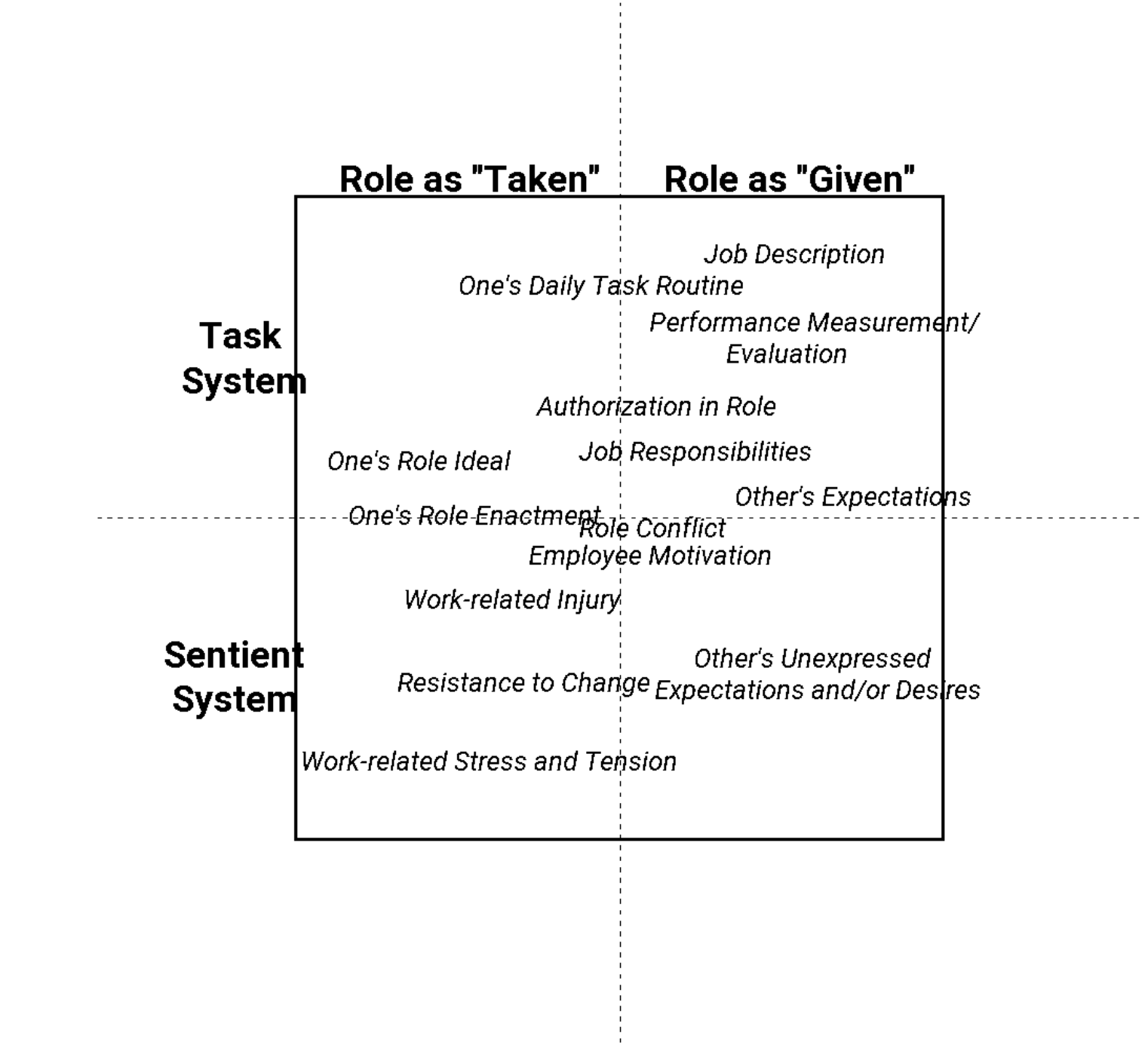
The Resulting Matrix: Role Taken and Given, and Task and Sentient Systems

Person-Role-System matrix showing Role Taken/Given and Task/Sentient systems

The Person-Role-System matrix — Role Taken and Given × Task and Sentient Systems

Understanding the System: Organizational Context and Environment

Organizations function as complex systems with key components:

System Elements
  • Defined inputs and outputs
  • Technical and social processes
  • External environment and market forces
  • Governance structures (boards, investors, owners)
  • Stakeholder relationships (employees, customers, partners, suppliers, etc.)
Guiding Principles
  • Vision and mission statements
  • Core values and culture
  • Strategic objectives
  • Performance metrics
System Changes
  • Product or service innovations, upgrades or enhancements
  • Mergers and acquisitions
  • Process improvements
  • Leadership transitions and team changes
  • Market shifts and competitive pressures

Common Challenges in Person-Role-System Navigation

Role Clarity Issues
Without formal processes for role discussion and development, organizations face:
  • Inefficient resource utilization
  • Lack of decision making
  • Wasted energy and effort
  • Unmet objectives and goals
  • Unresolved conflicts
  • Missed learning opportunities
Stress and Anxiety Factors
The complexity of managing personal identity, role expectations, and system demands creates inevitable stress and anxiety stemming from:
  • Unclear or unaligned role boundaries
  • Conflicting expectations between tasks, role holders, teams, etc.
  • Inadequate support systems and resourcing
  • Organizational change
  • Misalignment between personal and organizational goals
  • And so on…

Implementing the Person-Role-System Framework

For Leaders & Managers
Assessment Strategies
  • Conduct regular role discussions (weekly, monthly, quarterly)
  • Use 360-degree feedback effectively and frequently
  • Monitor person-role fit
  • Address system barriers to performance
Development Approaches
  • Provide targeted coaching and mentoring
  • Create clear role definitions and align roles throughout the organization
  • Align individual strengths with role requirements
  • Support employees through organizational change
For Coaches & Consultants
  • Help clients navigate role complexity
  • Address person-role-system tensions
  • Develop emotional intelligence, especially self-awareness and self-management skills
  • Build resilience and adaptability
  • Improve organizational role design
  • Reduce role conflict and ambiguity
  • Enhance team effectiveness
  • Support change management initiatives

Benefits of the Person-Role-System Approach

For Organizations
  • Improved employee engagement and satisfaction
  • Better role clarity and performance
  • Reduced conflict, turnover and wasted resources
  • Better decision making
  • Enhanced leadership effectiveness and organizational learning
  • Stronger organizational culture
For Individuals
  • Improved performance
  • Increased self-awareness and confidence
  • Better career decision-making
  • Improved stress management
  • Enhanced workplace relationships
  • Greater job satisfaction and fulfillment

The Value of Coaching

Coaching is a strategic tool for intelligent risk management at the intersection of person, role and system. Coaches help the person:

  • Clarify their role within the system
  • Align personal strengths with organizational needs
  • Manage change and resolve conflicts
  • Enhance decision-making, conflict management, communications and leadership skills
  • Achieve organizational goals and develop the organization

Conclusion: Mastering Organizational Role Navigation

The Person-Role-System framework provides essential insights for navigating the complex intersection of individual identity, role expectations and organizational systems. By understanding these three components and their interactions, leaders, managers, and coaches can create more effective, satisfying and productive workplace experiences.

Successful role navigation requires ongoing attention to the dynamic relationship between person, role and system. With proper support and understanding, individuals and organizations can optimize performance while maintaining personal authenticity and organizational effectiveness.

This framework serves as a valuable “GPS” for professionals seeking to enhance their effectiveness in complex organizational environments, providing the guidance needed for intelligent risk management and sustainable success.

Frequently Asked Questions (FAQs)

What is the Person-Role-System framework?
A model that examines how individual attributes, organizational roles and systemic factors interact to shape workplace behavior and outcomes.
How can organizations benefit from this approach?
By clarifying roles and aligning them with personal strengths and system needs, organizations can improve performance, efficiency and decision making, resolve conflicts, and support employee’s and the organization’s development.
Why is coaching important in this context?
Coaching helps individuals and leaders navigate complex role dynamics, manage change and achieve their full potential within the organization.
How can coaches learn more about the person-role-system framework?
Working with a senior coach, mentor or supervisor can dramatically improve one’s practice.

You can find the original article here.

Interested in the Person-Role-System framework?

Contact Marc to discuss implementing it in your organization.

Book a meeting with Marc →
Marc Maltz
Marc Maltz Partner, Hoola Hoop · Executive Coach
Share this:

What does a CEO do?

As executive coaches to CEOs, C-suites and boards, we see a lot of approaches to the role of the CEO. Some are successful and many are not. So what does a CEO do?

CEO Priorities and Key Responsibilities

Let’s start with the most important things CEOs need to be thinking about:

🧠
Emotional Intelligence (EI)
A CEO needs to be aware of their emotional self and in control of how those emotions are used and play out in the organization. The four quadrants of EI (self awareness, self management, relationships and managing others) are critical for a CEO. To quote a recent McKinsey article on Bad Bosses: “Narcissism. Overconfidence. Low EQ. Why do we persist in selecting for leadership traits that hamper organizational progress—and leave the right potential leaders in the wrong roles?”
🎯
Purpose
What is the company here to accomplish and how does it achieve profitability? In our studies of organizational resiliency, purpose was a leading attribute of success. Having a vision for the company’s future, developing a mission that drives the company, and creating the strategy for achieving the purpose are all key.
💰
Funding
Does the company have enough money in the bank and pathway to sustainability? Cash cliffs and getting to and maintaining profitability are amongst the most common issues that plague companies. Fiscal management and investor relations are essential CEO responsibilities.
👥
Leadership
To use Jim Collins’ metaphor, do you have the right people on the right bus and in the right seats? The talent a company starts with is rarely the talent that brings it through its growth stage. This includes all key roles in the company and the board of directors. A CEO’s assessment and management of talent is critical to the company’s success.
🌱
Culture
How should people behave and how should leadership represent the values behind behavior? A CEO’s leading by example is a great motivator.
⚙️
Operating a Business
The business’ operating system requires a number of things, including answering the following questions:
  • What does a company measure (and how often) to show it is on the right track? Measuring performance at all levels (individual, project, team, department and company) is vital to getting to accountability and profitability.
  • How often do leadership, teams, departments, and does the organization meet to talk about how it’s doing, where it’s headed, and other aspects of it’s journey?
  • What reporting is used to keep tabs on the business? Does everyone see and use the same data, is noise rooted out and is there a common understanding of what the data means?

Unique Challenges CEOs Face & the Role of CEO Coaching

CEOs sit in an unusual place in an organization. They are the ultimate authority in the company and are seen in ways by others that may or may not match how the CEO thinks and feels. The CEO carries all of the pressures of all of the company’s people, processes and performance. They are responsible for things that are usually beyond their awareness. And, CEOs need to be the resident expert on their business or at least know where to get answers within their organization. A difficult place to act from even in the best conditions. Dealing with all of these responsibilities is where executive coaching is vital. Having a coach who can be your partner in digging into these and other dynamics, helps you achieve success.

At Hoola Hoop, our CEO coaching focuses on these key factors of success. Through our executive coaching, we help the CEO understand their self, their team, their Board and other key stakeholders, building strong and successful relationships. We help the CEO grow, assess risk and build a sustainable enterprise.

Reach out if you would like to know more about CEO coaching at Hoola Hoop.

Interested in CEO coaching?

Book a 30-minute intro call with Eyal or Marc to explore how we can support your leadership and growth.

Eyal Goldwerger
Eyal Goldwerger Partner, Hoola Hoop · CEO Coach eyal@hoolahoop.io
Book a call →
Marc Maltz
Marc Maltz Partner, Hoola Hoop · CEO Coach marc@hoolahoop.io
Book a call →
Share this:

Executive Team Development

At Hoola Hoop, CEO coaching is considered part of the executive team’s development. CEOs do not operate alone, they engage and, in many ways, are dependent on the broader team. Team development focuses on the following:
🧩
Enhanced Strategic Thinking
It is critical to equip your executives with advanced problem-solving skills and a forward-thinking mindset to navigate complex business challenges to enhance the organization’s strategic approach.
🤝
Improved Collaboration
Developing a unified leadership team that works seamlessly and openly collaborates is important for the organization’s success.
🎯
Increased Accountability
Strengthen accountability across your leadership team and ensure that everyone is aligned with the company’s goals and objectives and with each other.
💡
Better Decision-Making
Empower leaders with the tools and insights needed to make informed, strategic decisions that drive business success.
The bottom line: a stronger executive team cultivates strong leadership that inspires and motivates, improving employee engagement and guidance, and business outcomes.

Our executive team development engages you and your team in the work of effectively running your business, including:

👤
01

One-on-one coaching

We provide ongoing executive coaching to individual members of the team. It is important to note that we maintain strict confidentiality in working with team members and do not play messenger. We do help members have difficult conversations with each other. We believe that in working with individual members of the team, it affords the coach an expanded view and allows for more active development of each participating member.

👥
02

Team coaching

Working with an executive team provides major benefits to the organization in helping the team better align, communicate, make decisions and operate the business. We typically participate in both monthly and quarterly business reviews (see below). We have seen dramatic improvements and high performance from teams that work at operating a business together, recognizing their dependencies and embracing their differences.

📅
03

Monthly and quarterly business reviews

As noted above, conducting monthly and quarterly business reviews brings the key aspects of the organization’s operating and strategic issues to the fore. The monthly business review looks at key monthly indicators for the business, what worked well and what could have been improved and how. This is also an opportunity to explore any strategic issues that may have surfaced during the month. The quarterly business review is a time of review, reflection and course correction. It is the opportunity for all management/leadership and individual contributors to review what has gone wrong with the strategy and how to course correct for the next quarter. These moments are also great development opportunities, including reviewing individual and departmental performance.

📊
04

Leadership and team assessments

We believe in being data driven in the development of our clients. Not only do we look at the financial and operating details of the business, we add two forms of data collection—360° reviews and standardized professional assessments. Our 360s are interview based, focusing on the strengths and development opportunities of the individual and team. We are also certified in a number of personality and leadership assessments which act as critical additional data for both individuals and teams. Team assessment profiles greatly enhance coaching and team development by allowing open conversations about individual’s different styles and beliefs.

Reach out if you would like to know more about executive team development at Hoola Hoop.

Elevate your executive team’s potential.

Book a 30-minute intro call with Marc to explore how we can support your team.

Book a meeting with Marc →
Marc Maltz
Marc Maltz Partner, Hoola Hoop · Executive Coach
Share this:

Motivation, Meaning and Resilience

Purpose, motivation, and resilience are essential for an organization to sustain success. These client case studies focus on what happens when an organization faces significant challenges due to trauma, M&A, market conditions, etc. All show a lack of clear purpose and confused organizational responses to change. We emphasize the importance of leadership in fostering a sense of purpose and motivation within an organization, and developing leaders with the qualities necessary to address the range of psychological stress organization’s endure.

Share this:

A Framework for Consulting to Organizational Role

Role is a complex key component of all organizations. We offer a framework for defining the way one works-in-role: their specific assigned duties, part in the overall mission, unconscious function, and the way they understand and work within an organization’s systems of tasks and sentience.

Share this:

Succession Planning and Management: A Comparative Study

Discover comprehensive insights into succession planning best practices through our analysis of 14 leading companies across multiple industries. This in-depth study examines the choices companies face when creating or improving their succession planning and management systems. It identifies several themes, including the role of human resources, the criteria for identifying high potential candidates, the relationship between performance and potential, and whether succession planning equals the promotional process. The research highlights essential strategies for minimizing operational risk while maximizing leadership development through strategic assignments. Organizations seeking to strengthen their succession planning processes will find actionable frameworks and industry-tested approaches in this detailed report.

There are five key findings that remain critical when planning succession in any organization:

1
Role of Human Resources (HR)
The HR and people function is a key strategic resource to the C-suite when scaling a business.
2
Criteria for Identifying High Potential Candidates
A performance management system must identify high potentials and their development path.
3
Does succession planning equal the promotional process?
How an organization thinks about succession is critical to its success. Who is ready for promotion is not the same as who are the successors to key roles.
4
What is the relationship between Performance and Potential?
We consider tools such as the “9-box” assessment as essential in considering where all of an organization’s talent sits in relation to performance and potential. Potential, the capacity to take on more in the future, is an often overlooked aspect of a person’s development.
5
Back-up/replacement or development of a pool?
In scaling companies, resources need to be identified in terms of risk abatement, do I have someone to take on a key role in an emergency, and in terms of developing the organization. The latter requires a thoughtful performance management system to develop talent, especially in identified key roles.

Thoughtfully scale your organization and manage the risks of who succeeds who as you grow. Hoola Hoop will help you build the right performance management process and succession plans to manage risk and scale.

Ready to build your succession plan?

Book a 30-minute intro call with Marc to explore how we can support your organization.

Book a meeting with Marc →
Marc Maltz
Marc Maltz Partner, Hoola Hoop · Executive Coach
Share this:

A New Perspective on Performance Management

Today’s performance management systems need a more effective approach that aligns with modern workforce requirements, emphasizing the importance of specific, in-the-moment feedback. One of today’s most valuable workplace assets is actionable, in-the-moment feedback, which is too often buried, lost or just not delivered in today’s ineffective performance management systems.

Traditional performance management systems are out-of-sync with the needs of the modern workforce. Employees and managers loathe the use of these systems and HR departments do not derive much actionable information from the reams of data collected along the way. One of the most valuable assets in today’s workplace is specific, in-the-moment feedback, an asset that is buried and often lost in today’s ineffective performance management systems.

What if there was a better way? In examining high performing organizations, we concluded that self-correcting systems have far greater promise. We are evolving the management of performance from a 360° performance management system, through “live 360s,” and now moving responsibility for managing performance into the team, utilizing the work as the criteria for evaluation.

Case Study — Return Path

At Return Path, we have worked to evolve how we measure and improve role and work performance, provide actionable feedback, separate evaluative from developmental conversations, and advance the overall “operating system” of the company. We began this journey 10 years ago, first developing a custom 360-degree performance system, then migrating to a standard commercial system as the company grew. This process began to take an enormous amount of time, especially for those who had to provide feedback on a number of people. We began to conduct facilitated “live 360s” for managers in which we would bring together a 360-degree view of a person’s key stakeholders for 45 minutes, resulting in a detailed report that highlighted important developmental opportunities. Yet, as we drove efficiencies into the organization, we wondered how to bring the conversation closer to impacting the work while simultaneously developing a culture of accountability and continuous feedback.

Return Path is the worldwide leader in email intelligence. We analyze more email data than anyone else in the world, using that data to power products so that only email people want and expect reach their inbox. As a values-based organization, we offer a casual work environment, where dreaming up new ideas is more important than following old formulas. Here, employees enjoy being part of a thriving company of smart, hard-working, innovative and passionate people who are committed to individual growth.

Return Path wants all employees to be engaged and satisfied — offering an array of programs to empower employees to acquire new skills, develop as leaders and chart an enviable career. We focus on trusting employees and design all processes to increase freedom wherever possible; we don’t have one-size-fits-all solutions. The impact is that Return Path has been ranked No. 11 in the United States as a Great Place to Work by Fortune Magazine, recognized by Crain’s in New York City, and ranked by Colorado Business Magazine as one of the top three employers in Colorado.

As part of our journey, we spent time in numerous organizations exploring what ideas drive excellence1. We learned that teams fully authorized for managing and measuring their work performed the best. In fact, our own technical departments who had adopted an agile/lean approach stood out as great examples of higher functioning teams. We are in the process of changing how we operate to put the team in the driver seat by:

1
Asking every team and team member to identify what they are responsible for delivering and to whom in the organization. Once established, team members/teams meet with their stakeholders to negotiate deliverable(s) and determine how performance will be measured.
2
Establishing personal/team charters in which people/teams commit to delivery within the measures established. These charters will be published openly, amended and commented on by any person who has input or is impacted by the outcome.
3
Identifying personal and team development needs that will improve performance. Once established, these individual/team documents are published as a development plan.
4
Measuring performance and publishing these data on company-wide dashboards.
5
Providing facilitated (teams will ultimately be trained to self-facilitate) feedback sessions to review individual/team performance in short cycles (weekly, biweekly, monthly, etc.) much like the lean “sprint.”
6
Ensuring individual development conversations are continuous among all teammates and, at a minimum, conducted every 60 days.

“One of the most valuable assets in today’s workplace is specific, in-the-moment feedback, an asset that is buried and often lost in today’s ineffective performance management systems.”

Neither management nor our “People Team” will intervene unless requested. The manager becomes a facilitator, focusing on team performance, coaching teams and individuals, and refining the operating system for which they are responsible. Managers will also receive feedback from their teams and their peers in the same way as described above.

While currently the intent is to allow managers to use this “crowd sourced” feedback as key decision data when evaluating performance and compensation, our hope is to bring the organization to a place where the entire process is transparent and performance, performance development and compensation decisions are solely owned by the team.

We are giving the responsibility for managing performance to where it has the most impact, to the 375 people across our company. We will monitor progress as we evolve our way of operating, allowing Return Path to internalize this new way of working. Our hope is to dramatically improve performance, eliminate less efficient practices, and move review processes to those who deliver, measure, develop and manage the work of our business.

Ready to rethink performance management?

Book a 30-minute intro call with Marc to explore how we can support your organization.

Book a meeting with Marc →
Marc Maltz
Marc Maltz Partner, Hoola Hoop · Executive Coach
Share this:

The Complexity of Leadership

In complex organizations, leaders face multidimensional psychological challenges. Using the case of Arthur Andersen, a company that failed due to leadership’s inability to respond to the powerful dynamics of authorization, we discuss the importance of adaptive leadership, psychodynamic organization theory and Interpersonal psychoanalysis to understand the complexities leaders face. Successful leadership requires transparency, emotional competence, charisma, effective delegation, decisiveness, and adaptability.

Share this:

Finding You in Me

The 9/11 attacks on the World Trade Center devastated this investment bank. We discuss our work in helping Sandler O’Neill & Partners’ remaining managing director, employees and families, recover from the trauma of losing 39% of their friends and colleagues. We present the challenges and successes of bringing together survivors, families, volunteers and new employees in the work of honoring the dead while rebuilding the firm.

Share this:

Organizational Thinking, Leadership and Subsequent Action: Psychoanalysis as a Guide?

Through a case study of a senior executive at a foreign bank, we look at the complex dynamics between leadership, teamwork and organizational culture, and how to help leaders navigate the challenges of a rapidly changing business landscape. We address the importance of understanding the psychological factors that drive individual and organizational behavior and decision-making; the role of leadership in fostering creativity and innovation; and the challenges and opportunities presented by organizational culture and its political dynamics.

Share this:

Psychological Containment: A Critical Leadership Success Factor

Leaders must be able to identify and manage workplace stresses and anxieties, what we call “troubling, frightening bits” or TFBs, that originate from employees, work, organizational dysfunction, and external events. If unaddressed, TFBs can negatively impact an organization. “Psychological containment” is the ability to keep TFBs within limits, enabling teams to stay focused and aligned through self-understanding, self-management, managing group dynamics, and establishing appropriate organizational boundaries. Psychological containment is an essential leadership capability that enables organizational survival and high performance even amidst devastating events.

In a pandemic, physical hygiene becomes a number one priority. But current conditions present extensive challenges to psychological hygiene. Organizations depend on psychological well-being to enable focus at work, team functioning and action in the interest of the whole. Yet few take psychological hygiene seriously and fewer still do all they should.

In the aftermath of 9/11, we developed a practice of psychological containment to enable organizational functioning under extreme conditions. Since then, we’ve worked with dozens of organizations both amidst crises and in periods of relative calm. In helping these firms, we’ve honed our understanding of psychological containment as a critical and largely overlooked leadership success factor—one that’s never been more needed.

Containment, in simple terms, is the action of keeping something under control or within limits. That something could be political, medical, economic, military, etc., anything from the spread of a virus to the geopolitical influence of an adversarial nation.

Psychoanalyst Wilfred Bion developed the term “containment” to describe the capacity to internally manage troubling thoughts and feelings, and TFBs. In psychotherapy, the therapist and patient work together to contain the patient’s distress to get to a place of understanding, which, in turn, leads to the potential management of these feelings and the responses they evoke.

Output and process of organizations today is far more mental than material. As such, they act as cauldrons of all variety of TFBs from both within and beyond, including many that pose particular containment challenges:

1
TFBs that individuals bring with them, e.g., their beliefs, political views, trauma, domestic problems, addictions, etc.
2
TFBs from the work itself, e.g., overly-repetitive work; dealing with sadness, pain and suffering; and extremely stressful work, including life-threatening situations. And not only from undesirable causes—office romance, for example, can be among the most important TFBs to contain.
3
TFBs from organizational dysfunction, such as unfair treatment, unmanageable workload, lack of role clarity or alignment, lack of communication and support from above.
4
TFBs that come from beyond the organization’s boundaries, its ecosystem, including ineffective or oppressive governing institutions, overly powerful suppliers or customers, cut-throat or unfair competition, disasters (natural or man-made), and extreme uncertainty such as experienced with respect to Covid-19.

For an organization’s work to get done, TFBs must be identified, monitored and contained.

Most leaders and organizations have long been able to ignore psychological hygiene because TFBs created by their work and management processes (items #2 and #3 above) are absorbed by their people (#1) or a larger container (#4). Management gets by despite neglect or even abuse because unsung underlings—usually under-appreciated and often unrecognized—manage TFBs for them (sometimes at a significant personal cost).

Employees often bring TFBs home (e.g., high family violence rates among law enforcement workers) or internalize them (e.g., high suicide rates by health care workers). Or the containing organization absorbs the costs. When large, powerful organizations (Enron and currently Boeing) or entire industries go bad (the financial crisis of 2008–2010), it wreaks havoc—communities suffer and taxpayers pick up the bill.

Individuals and ecosystems become saturated, incapable of absorbing additional spillover. Organizations will not only have to better manage their own TFBs but those that additionally pour in from employees, customers and beyond their own boundaries.

Successful leaders will not only have to contain TFBs that emerge in the workplace but also ensure that those originating from beyond the organization do not derail their work.

Increasingly, leaders will have to recognize and monitor TFBs from all four sources, and use these data as critical input to how to guide the organization forward.

The past century’s declines in physical demands have been accompanied by increasing psychological demands. The Covid-19 world produced unprecedented challenges including work-from-home—especially the schooling and care of children; the toll of too many sedentary hours spent on electronic devices; the deterioration of trust in the absence of physical interaction and face-to-face meetings; the deterioration of governmental and other institutional services; undermined routines, especially real world interactions with friends; and the loss of many options for relaxation, enjoyment, rejuvenation and recovery.

For much of the workforce, it’s worse yet, including sickness, bereavement, absence of physical contact, separation from loved ones and general isolation. The resulting upheaval in the economy adds to these stressors. Most people have concerns about the long- and short-term viability of their job, organization and financial future. Finally, add in recent social upheaval and any leader has to wonder ‘how can these not severely effect work?’

Current challenges are severe. Some organizations have already come apart; many others are barely holding together. As we continue into a long summer—on track to be the hottest on record—and (in the US) a contentious upcoming election, the prospects for productive work seem precarious. And, we have helped organizations through it.

We recently shared insights that derived from our research and work with Sandler O’Neill and Partners in the wake of 9/11 on (1) effectively using crisis and (2) the astonishing power unleashed by combining a strong shared moral purpose with personal opportunity. But Sandler could not have gotten to that point had we not addressed the psychological needs of the survivors.

Case Study — Sandler O’Neill & Partners

On September 11, 2001, Sandler’s office on the 104th floor of the World Trade Center was destroyed. Sixty-eight employees were killed, 40% of its workforce, including two of its three founders, one-third of its partners, almost their entire equities desk, its entire securities desk and all of its bond traders. Four visitors were also killed, all told, 72 co-workers, who were also spouses, parents, sons and daughters, and friends.

For greater depth, see the separate story on Sandler’s loss and recovery.

We were introduced to this tragedy the following day as survivors convened at a temporary space in midtown Manhattan. That space allowed for taking stock, gathering and grieving. We began working immediately to care for survivors and the families of those lost as well as to consult about rebuilding.

Our consultation deployed psychological containment from the onset. We worked with surviving leadership to assure coverage for critical needs:

  • Care for the families of the deceased
  • Care for employees
  • Communicating with customers/stakeholders
  • Communicating with governing authorities
  • Media relations
  • Taking stock of and managing the business
  • Managing the numerous memorial services and the firm’s memorial service held at Carnegie Hall

We also promptly established three teams of consultants and clinicians to:

  • Care for the families of the dead—private counseling and group sessions for families and retreats for the many children who lost a parent.
  • Care for employees—private counseling for all employees; workplace monitoring; and group counseling, initially divided into five groups by 9/11 experience:
    • 17 who had been in their offices that morning but left despite advisories
    • 24 who were on the concourse
    • 40 who were traveling or not yet at work that day
    • 22 who were in satellite offices
    • The many volunteers who helped out in the initial weeks and new hires (it wasn’t easy for them either)
  • Work with surviving partners to rebuild the business

In the aftermath of 9/11, grief, distress, anxiety and trauma were everywhere. Establishing immediate psychological safety was impossible. Would there be further attacks? Would this escalate into an extended crisis? Yet daily incremental progress was made, and containment was ultimately achieved through multiple efforts, as follows.

Leadership — critical attributes
  • Continuity—the sole remaining founder and managing partner, Jimmy Dunne, immediately formed a new team to lead the firm through the days (and years) ahead. Dunne and two colleagues established a core team in the spirit and image of the original managing partners, not to duplicate them but to replace what they brought to the firm.
  • Confidence in the future—despite the devastation, Dunne never wavered. He exuded the confidence for others to believe that the firm would survive, even thrive.
  • Confidence in the present—surviving partners used their presence to affirm that the business was under control and that others were doing their jobs thereby enabling employees to focus on their own work.
  • Emotions—appearing on MSNBC a few days after 9/11, Dunne broke down in tears. A tough Bear Stearns banker whose previous emotional displays were limited to angry dress-downs, Dunne’s emotional display gave permission to all involved to outwardly show their feelings. If Dunne could cry, so can I, dispelling the tough Wall Street persona, enabling a normal affect. This affect also helped people identify with Dunne and thus internalize his confidence and his emotional state as their own. When he expressed grief, he was openly expressing their collective and individual grief.
  • Flexibility—different situations call for different types of leadership. Dunne’s transformation was particularly remarkable. Previously he had been an enforcer, respected but rarely sought out; for that, employees would turn to the other two founders. But with his friends gone, Dunne and other leaders rose to the occasion and transformed themselves into what the firm needed on any given day.
Organization as a container — stakeholder support and mechanisms
  • Monitored the mental and physical health of employees, their families and the families of those lost.
  • Established a coordinated community of support:
    • Partners and their spouses in frequent communications with assigned families
    • Colleagues “buddied-up” to monitor each other’s emotional and physical well-being
    • Support for clients and friends of the firm managed in the same spirit
  • Gradually merged support groups to bring together disparate experiences, find common themes and expand in time to the firm-as-a-whole.
  • Aligned roles and responsibilities, established new standard operating systems and stress-tested the firm’s strategy and finances.
  • Worked with the community, partners, managers and employees to lead the firm through a conscious reframing of the trauma from a tragedy to the establishment of a “renewed” firm.
Containing grief
  • Managers and partners were taught to develop empathy and allow for the expression of emotions, building the firm’s capacity to care for its own.
  • A room was set aside for anyone feeling overwrought, thereby reserving workspace for actual work. Those who could still not sustain work after many months were provided generous packages as they left the firm.
  • Even the memorial service that was held at Carnegie Hall added to the containment by offering a public display of grief, an honoring of those lost and a demarcation between what happened and what was to come. Caring for each other, an unspoken part of Sandler’s legacy prior to 9/11, was rebuilt in a way that attended to each person and the firm.

Psychological containment skills and practices enable leaders to transform potentially toxic TFBs into productive work and outputs. We continued to work in a formal relationship with Sandler on these issues for five years, during which time the firm experienced an astonishing resurrection and sustained period of success, expanding into new markets, and steadily growing capabilities and profits. As we’ve worked with Sandler and dozens of other organizations in a wide variety of situations, we’ve honed our understanding of psychological containment as a leadership success factor. Containment is both psycho-social, helping to contain individual and collective stress and anxiety, and technical, establishing protective role and task boundaries.

Organizations are microcosms of society. The people who work inside and stakeholders who make up the organization’s ecosystem bring with them stressors that add to tensions experienced within. Leaders have to be sympathetic and empathetic to this myriad of stressors and work to contain them.

Managing these confluences can be a daunting task that’s unique to every situation. We have collected an array of practices, tools and understanding—some of the most important that leaders need to master and employ are:

🪞
01

Self-understanding

A leader needs to be able to first understand the range of their own TFBs, especially being in touch with their own affective range, including anxiety, anger and love.

🧘
02

Self-management

The number one cause of executive failure is the lack of impulse control. Self-management is the ability to recognize and control one’s emotional response. It’s being aware of triggers—physical, cognitive and/or emotional—and being able to manage their inward compromises in order to stay focused and outward displays to keep others focused.

💭
03

Projection

A “Silicon Valley” CEO on his way to a retreat rattles off directives to underlings who are preparing for a massive product launch. Shutting the car door, he adds, “Oh, the bear is sticky with honey.” Not knowing he was referring literally to a bear-shaped honey container, the puzzled underlings spiral out of control. They hold meetings to debate and interpret what he meant and completely redesign the product launch, even flying in a bear for the event. A leader’s passing comment, even a gesture, can be taken as a mandate. Complicating matters are “projections”—a common means of defense subconsciously employed to cope with difficult emotions. Undesirable feelings may be projected onto others, including leaders, rather than recognized and dealt with. These can lead to assumptions at odds with intentions. To influence these projections, leaders must recognize emotional responses shaped by TFBs about role, company, etc.

👥
04

Group dynamics

Small teams need time and opportunity to explore others’ statements and TFBs and to clarify intentions and perception. In large groups, people are often left to their imagination or collective anxiety. When unaddressed, these can feel like reality, leading them to act independently on fantasies, potentially in conflict with the leader or group.

🏗️
05

Technical containment

Technical containment is the act of providing structure, decision rules and clarity to work. Technical “boundaries” include defining roles and tasks, clear communications, decision-making transparency, and establishing authority and access to information. Done properly, this relieves anxiety and stress. Leaders must strike a balance as the overuse of authority is as dysfunctional as underuse. Too much structure or too many rules can stifle innovation or make the group unsafe for those who don’t perfectly conform. Anxiety occurs at all organization’s boundaries, be it between individuals, roles, teams, departments and their broader stakeholders. Leaders must establish, align and monitor these boundaries so as to keep stress, anxiety and other potent emotions to manageable levels, and authoritatively respond if they threaten to spill over.

“No one cares how much you know, until they know how much you care.”

— Theodore Roosevelt

The world is full of experts who use knowledge primarily for their own advantage. Roosevelt recognized that people are wary of advice—and wise to be wary—until they trust that those providing advice have their best interests at heart. So even a caring leader has to show that they care. That, in turn, requires an ability to empathize—to understand and relate to employees, colleagues, constituents and other stakeholders’ feelings, reasoning, perspective, position, and so on. This empathy is essential for (1) identifying underlying emotions and anxieties; (2) as data to inform actions to promote psychological hygiene; and (3) generating trust in those whose TFBs you hope to influence.

Psychological containment is challenging. It spans understanding and managing motivations, working with complicated individual and group dynamics, and listening below the surface to best align an organization.

Recent years have been tough for everyone, including leaders: the initial Covid-19 fears, dread, lockdown and resulting economic uncertainty; the protests, riots and chaotic political and governing conditions; and now the continuing uncertainty about the economy, elections, war and so on. It’s a minefield. Even the best of intentions can lead to blow-ups.

When dealing with most situations, especially where there are differences, containment and reacting cautiously, patiently and thoughtfully, with empathy, sharing relevant experience and from-the-heart sentiments, are important lessons. Leading is more than developing the right vision, mission and strategy; more than marketing plans, financial statements and operations. Leading is about caring for the people who carry-out the strategy and operate the business. And showing them that you care.

Readers are likely familiar with concepts of psychological safety and emotional intelligence. Psychological safety, though difficult to achieve, critically helps provide an environment in which people trust their colleagues and can openly communicate. Emotional intelligence is necessary to deploy many of the containment tools noted above. Psychological containment requires considerably more from leadership, and “more” will immediately relate to organizational output. It means containing one’s own stress, anxiety and other TFBs from spilling out into the workspace, and those of everyone associated with the organization and its ecosystem.

It means containing as much of the stress, anxiety and negative emotions that arise beyond the organization from pouring in—and vice versa, limiting the toxicity that flows out into the environment. In short, containment is the critical leadership practice needed to provide a psychologically clean-enough workspace to allow people to focus at work, facilitate team functioning and do the right thing for the organization and beyond.

Psychological containment requires individual and organizational capabilities not normally expected of leaders, perhaps least of all for type A-personalities that generally rise to the top. It requires new tools, learning and ways of operating. It’s never easy, least of all now, and some will resist. Yet as we learned in the aftermath of 9/11 and in the more than two decades since, it can help organizations both survive even the most devastating of disasters and allow them to thrive. Even amidst crisis and chaos, psychological containment can enable new heights of performance and success that you may never have imagined possible.

Strengthen your organization’s psychological containment.

Book a 30-minute intro call with Marc to explore how we can support your leadership.

Book a meeting with Marc →
Marc Maltz
Marc Maltz Partner, Hoola Hoop · Executive Coach
Share this:
Let’s Talk

Thank you for your interest in Hoola Hoop’s approach to executive coaching.

We’re excited to help you unlock your and your organization’s full potential. Please share a few details about yourself and your coaching needs. Let’s start this transformative journey together.

    *Required fields